Thursday, April 18, 2013

Honk If You Like Electrolytes

A middle aged man is found down by EMS with a GCS 5. His neighbor reports that the patient was "feeling sick for several days and hadn't been seen." He is intubated in the emergency department for protection of his airway. Exam shows decreased skin turgor and dry oral mucosa. ABG shows pH 7.32, PaCO2 43mmHg, PaO2 240mmHg. A chemistry panel shows sodium 130, potassium 5, chloride 100, bicarbonate 19, BUN 40, Cr 1.4, and a serum glucose >1000mg/dL. CBC shows WBC 18, Hct 48, Plts 200. Urine dipstick is positive for leukocyte esterase and nitrites, negative for everything else. Urine culture grows out gram negative rods.

Challenge: What's the diagnosis?

Image of insulin in the public domain, from Wikipedia.

Monday, April 15, 2013

Shield

This girl is on recombinant human growth hormone therapy for her height. When she was born, she had lymphedema of her hands and feet. As a child, she had recurrent urinary tract infections. She has not yet started menstruating. In her 20s, she will be diagnosed with hypothyroidism from autoimmune thyroiditis. Screening labs in her 30s will show elevated liver enzymes. She will never have children. In her 40s, she will develop hypertension and osteoporosis.

Challenge: What's the diagnosis?

Image shown under Creative Commons Attribution License.

Thursday, April 11, 2013

Totalitarian

Challenge: You're rounding in the ICU and see an EEG monitor with this waveform - what is it?

Image shown under Fair Use.

Monday, April 8, 2013

Switch

Challenge: This EKG is taken in a pediatric patient who is not cyanotic; in fact, the patient has no signs or symptoms, but has a future risk of arrhythmia and heart failure. What's the diagnosis?

Image shown under Fair Use.

Thursday, April 4, 2013

Blind Leading the Blind


This image shows young children in West Africa leading blind adults. The first symptom of disease is generalized itching with inflammatory papules, nodules, and plaques. The etiology of the blindness can be seen on slit-lamp examination:
Patients often have subcutaneous nodules 0.5-3cm in diameter over their iliac crests and pelvic girdle. They occasionally have inguinal lymphadenopathy.

Challenge: What's this disease seen commonly in endemic populations but rarely in travelers?

First image shown under Creative Commons Attribution Share-Alike License. Second image shown under Fair Use.

Monday, April 1, 2013

Slinky

Challenge: You're a radiologist; the team ordering this film gives no clinical information. What's your best guess to the diagnosis?

Image shown under Fair Use.

Thursday, March 28, 2013

Birds of a Feather

Challenge: What do all these have in common: quinidine, amiodarone, erythromycin, pentamidine, voriconazole, levofloxacin, TCAs, haloperidol, sorafenib, risperidone, methadone, ondansetron, and protease inhibitors?

Image is in the public domain, from Wikipedia.

Monday, March 25, 2013

Two Patients


A 30 year old G3P1 African-American woman with BMI 35kg/m2 and a past medical history of hypertension presents for a prenatal visit. Her prior baby was a 37 week 10 pound newborn who was admitted to the NICU for respiratory distress syndrome, hypoglycemia, hypocalcemia, hypomagnesemia, and polycythemia.

Challenge: Why?

Image is in the public domain, from Wikipedia.

Thursday, March 21, 2013

March Fracture

A runner increases her activity significantly after joining the college track team. A few weeks into her routine, she starts complaining of intermittent forefoot pain that occurs only with running, jumping, and dancing. The pain worsens until it occurs constantly with weight-bearing. On exam, you note point tenderness and swelling. When you hold the toe in line with the foot without angulation, pushing the toe into the metatarsal produces pain.


The first X-ray (A) is taken at this visit. The second X-ray (B) is taken 4 weeks later. The third X-ray (C) is taken 3 months later.

Challenge: What's your diagnosis?

Image shown under Fair Use.

Monday, March 18, 2013

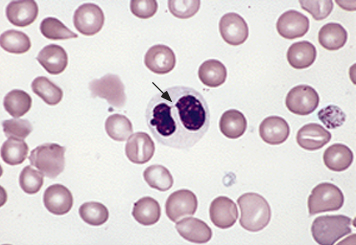
Band

Challenge: Your medical student thinks this is a band in a patient with myelodysplasia, but you know better; what is it?

Image shown under Fair Use.