Monday, May 17, 2010

OCPs

Today's case is not a diagnostic dilemma, but rather a patient education question. A 25 year old woman comes to your clinic because she is interested in starting combined oral contraceptives.

Challenge: Which of the following will she need before starting the pill: a breast exam, a pap smear, an STD screen? When should she start taking the pill? What are the contraindications to combined oral contraceptives?

Image of OCPs is from Wikipedia, shown under GNU Free Documentation License.

Friday, May 14, 2010

No Case Today

Hi everyone,

Since today is medical school graduation for me, there will be no case of the day. Enjoy the day off! There should be a regularly scheduled case on Monday. Thank you all for your participation. I have thoroughly enjoyed writing these and I hope they are fun and educational. I'm not sure when I will end this blog, but I will keep it going for the next month at least.

Craig

Wednesday, May 12, 2010

Previously Healthy

A 30 year old previously healthy man presents with high fever, tachycardia, hypotension, and severe localized pain of his left lower extremity. The leg has tense edema, red-purple erythema, crepitus, blisters, and bullae, but the pain seems to be greater than he should feel with these findings. The pain has been rapidly increasing over the last day or two. C-reactive protein is 180 mg/L, WBC is 30,000/uL, Hgb is 10 g/dL, sodium is 132 meq/L, Cr is 1.6 mg/dL, glucose is 190 mg/dL. Gram stain is shown above.

Challenge: What's the diagnosis? What's the bug?

Image is shown under Fair Use.

Monday, May 10, 2010

An 18th Century English Author Had This Disease

A 7 year old child presents with "weird" movements and utterances. Throughout the day, he will have involuntary facial grimacing and shoulder shrugging. The symptoms wax and wane. When he concentrates really hard, he can suppress them, but otherwise, he feels an irresistible urge before the movement and great relief afterward. He says he can tell when they're coming on. His teacher has sent him home from school multiple times for saying "bad words." Review of systems is positive for restlessness, insomnia, enuresis, somnambulism, nightmares, and bruxism. His parents have observed his weird movements in his sleep. A head MRI is negative.

Challenge: The person shown in the image above also had this disease. What is it?

Image is in the public domain.

Friday, May 7, 2010

Asthma III

A 36 year old presents with several months of fever, weight loss, malaise, fatigue, and a new wrist drop. All of his medical problems started about 16 years ago, he says. He was diagnosed with allergic rhinitis when he was 20, eczema when he was 24, and asthma when he was 28. At age 32, he was admitted with pulmonary opacities, an eosinophilic pleural effusion, and peripheral eosinophilia. They didn't know what to make of it, diagnosed him with an asthma exacerbation, and sent him home.

His asthma is poorly controlled on moderate doses of inhaled corticosteroids. He has required several courses of systemic glucocorticoids to control his symptoms. He's had multiple exacerbations requiring ED visits, hospitalizations, but no intubations.

His allergic rhinitis has been evaluated by an ENT and the endoscopic image is shown above. The white arrow points to the middle turbinate and the red arrow points to the nasal septum. The black arrows represent the findings. The patient also says he gets recurrent sinusitis.

Most recently, the patient complains of the skin finding shown above on his elbow. It is tender, nodular, and subcutaneous. On exam, you also note a foot drop.

Challenge: Making the diagnosis is important as cardiac complications can be serious. What do you think this is?

Images shown under Fair Use.

Wednesday, May 5, 2010

Asthma II

You are a pediatrics intern on your first day of clinic. Now you get third year medical students running around for you! You send a medical student to see a 2 year old who is "fussy." The medical student comes back about an hour and a half later, fumbling through pages of notes. He says this is a 2 year old with no significant past medical history and a normal birth history who presents with irritation that started about an hour ago. He was in his crib, unmonitored, when he began to cry. The parents don't know what was wrong and brought him into urgent care. The child has had a nonproductive cough.

You wonder why that history took an hour and a half to obtain. You also wonder what's on the five other scribbled pages of the medical student's notes. Oh well.

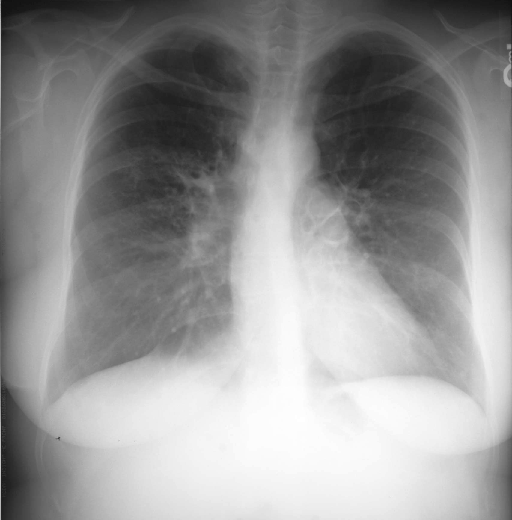
The student reports a definite wheeze, but he only heard it on the left side. There were decreased breath sounds on that side too. You're not sure why, but the medical student got chest X-rays, shown above. The right CXR is expiratory and the left CXR is inspiratory. The CXR does not improve with bronchodilators.

The med student hedges on the assessment and plan. The differential diagnosis, he says, is asthma definitely, and also...

Challenge: Your student hesitates, waiting for you to fill in the more likely diagnosis which is what?

Image shown under Fair Use.

Monday, May 3, 2010

Asthma I

This week is not only pulmonary week, it is asthma week.


The CXR and CT shown above are from a patient referred to you because she has asthma that just won't go away. She is 30, but she had asthma since she was a child. Every year, she gets a few exacerbations with bronchial obstruction, fever, malaise, cough productive of brown mucous plugs, and occasional hemoptysis. Her blood counts always show peripheral eosinophilia. Wheezing is present. These episodes are only minimally responsive to bronchodilators such as albuterol and ipratropium, but they respond well to systemic steroids. Pulmonary function tests show airflow obstruction, air trapping with a reduced FEV1, and increased residual volume. Improvement is minimal with a bronchodilator. A skin test shows reactivity to Aspergillus antigens, serum antibodies against Aspergillus are positive, and serum total IgE is elevated >1000 ng/mL.

Challenge: The referring doctor asks what antibiotics he should use for this infection?

Images shown under Fair Use.

Friday, April 30, 2010

Separation

(Click to enlarge)

Challenge: What is your diagnosis?

Image is in the public domain.

Wednesday, April 28, 2010

Hugs and Kisses

This girl is short for her age. She was also diagnosed with a horseshoe kidney.

Challenge: What is the most common cardiovascular anomaly in patients with this disease?

Image shown under Fair Use.

Monday, April 26, 2010

Where's the Lesion?

A 20 year old presents with a seizure. He says he felt a rising roller-coaster sensation in his stomach, a feeling of deja vu along with intense fear, and a weird smell. Then his roommate noticed he had a behavioral arrest with staring that lasted 30-120 seconds. The patient was unaware and unresponsive during this time, but he did have stereotyped purposeless fidgeting of his hands. At this time, the roommate called 911. The patient does not remember anything.

Challenge: If you were to guess where the lesion is, what would you say?