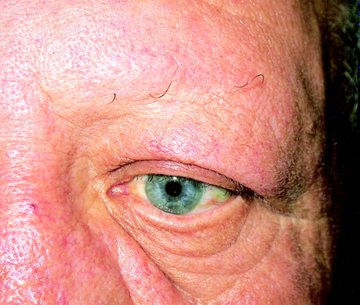
A 30 year old man comes in with fevers, chills, malaise, and myalgias. He has no significant past medical or surgical history. He takes no medications. He has no allergies. On review of systems, he notes dysuria, perineal pain, and cloudy urine. He also has urinary dribbling and hesitation. He initially thought this was a urinary tract infection and took a 2 week course of amoxicillin-clavulanate (Augmentin) but his symptoms persisted. He is an avid bike rider and has been training for 8-hours a day. He is not currently sexually active. He denies smoking, but drinks a beer occasionally and smokes marijuana occasionally.
If a biopsy were taken, the image above might be found.
Challenge: If this is more than a UTI, what is it?
Image shown under Creative Commons Attribution Share-Alike License.
Thursday, December 8, 2011
Monday, December 5, 2011
Wrong Place, Wrong Time
Both of these can be diagnosed with fetal ultrasound and materal serum AFP. Obstetrics, pediatrics, and surgery all play key roles in diagnosis and management.
Challenge: What congenital anomalies are seen here? (They are two distinct entities)
Both images shown under Fair Use.
Thursday, December 1, 2011
Canada? Canada!
A 40 year old man comes in with a soccer injury. He twisted his ankle in a game and has ankle pain. On exam, he can bear weight but limps. There is tenderness at the distal 6cm of the posterior edge of the fibula.
Challenge: Do you take ankle X-rays and why?
Image is in the public domain, from Wikipedia.
Challenge: Do you take ankle X-rays and why?
Image is in the public domain, from Wikipedia.
Monday, November 28, 2011
Demon
Suddenly, the patient screams in pain and starts clutching the side of his head saying he is having an attack. On exam, you wonder if he has a unilateral Horner's syndrome. You're not sure because he does seem to sweat. His eye is pretty red and you wonder about conjunctivitis. The patient can't give further history but says it'll get better within the next 15-30 minutes. The rest of the exam is unremarkable, except for a pack of cigarettes in his shirt pocket.
Challenge: Other than danger to self, what's the diagnosis?
Image is shown under GNU Free Documentation License.
Monday, November 21, 2011
The Grecian Bend
This posture, seen with female socialites in the late 19th century, looks similar to workers building the Brooklyn Bridge in 1883.
These days, you don't see much of that disease. But instead, you see something related to the liquid shown above. You're on a plane flying from San Diego to New York when you hear an overhead page, "Are there any doctors on board?" Reluctantly, you hit your call button.
A few minutes later, you are rushed to the aisle-side of a 30 year old gentleman. "I knew I shouldn't have gotten onto the flight," he says. "In the airport, I just had the sense that something was wrong, I was tired, everything hurt, I had no appetite, and I had a splitting headache. Now, my elbows and shoulders hurt, and my chest itches. My arms and legs feel weak and they're tingly too."
When you examine the patient, he has full range of motion of his joints, pain is not exacerbated with movement, and there is no erythema or swelling of his elbows or shoulders. He does have some erythema on his chest and some mottling with cyanosis. His neurologic exam is significant for some mild weakness of the extremities. His pulse is 80. He doesn't feel febrile. You try to take the blood pressure with the airplane's sphygmomanometer and stethoscope but can't hear a thing. His respiratory rate is 18.
Challenge: You forgot to take a social history on this patient. What are his hobbies?
First image is in the public domain. Second image is shown under Creative Commons Attribution Share-Alike License.
Thursday, November 17, 2011
Stigma
This patient notes that the lesion by his eye is numb. He also has hypopigmented lesions on his nose and testicles. All of these lesions have decreased sensation. On exam, you also note that he has no eyebrows. In fact, advanced forms of this disease can be associated with saddle nose deformities and hoarseness. On examination, some nerves appear enlarged and tender such as the greater auricular nerve, common peroneal nerve, and ulnar nerve.
Challenge: Thinking of the geographic distribution of the abnormalities, what's your diagnosis?
Image shown under Fair Use.
Monday, November 14, 2011
Overanxious Parents
At a two-week visit, parents bring their newborn into your office, worried because she has had a few days of bloody mucoid vaginal discharge. A week later, this has resolved.
Challenge: What's the physiology?
Thursday, November 10, 2011
Gender
Two children present with the same disease.
A 5 year old boy is evaluated because he has gotten two urinary tract infections in the last six months. He is toilet trained and never has any problems. However, a renal ultrasound shows a dilated ureter.
A 5 year old girl presents with constantly wet underwear. She is toilet trained and has normal voiding habits but has persistent moisture in her underwear. When she sits in her parents' lap, this wetness is more pronounced.
Challenge: What's going on?
Image is from Wikipedia, shown under Creative Commons Attribution Share-Alike License.
Monday, November 7, 2011
Earthquake
A 70 year-old patient is referred to neurology clinic, and before meeting the patient, you review the chart. This EKG stands out to you. Initially, you think it's one rhythm, but then you take a look at every single lead.
Challenge: What is the patient referred to you for?
Image shown under Fair Use.
Thursday, November 3, 2011
Fentanyl
A young man with no past medical history comes in after a motor vehicle accident. His primary and secondary trauma evaluations show a couple fractured bones and some ecchymoses. There are no other injuries. Both the resident and the attending each write for 100mcg fentanyl IV push for pain, and the nurse ends up giving 200mcg all at once. Suddenly, the patient has trouble breathing. He's awake and alert, so it doesn't appear to be respiratory depression from opiates; instead it seems that his tidal volumes have significantly decreased.
Challenge: How does the patient's chest wall feel and why?
Image shown under Fair Use, from usfca.edu.
Challenge: How does the patient's chest wall feel and why?
Image shown under Fair Use, from usfca.edu.
Subscribe to:
Posts (Atom)