Thursday, July 17, 2014

Skulls and Crossbones II


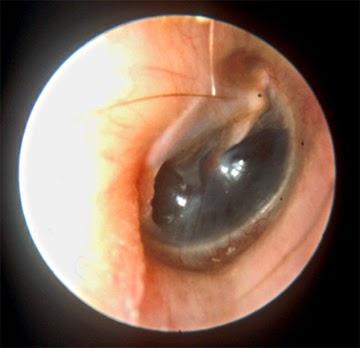
This patient is found down in a park and brought to the emergency department. He is complaining of headache, nausea, and vomiting. He has hearing loss so otoscopy is performed and shown above.

Challenge: What's the diagnosis?

Images shown under Fair Use.

Monday, July 14, 2014

Skulls and Crossbones I


This patient is found down in a park and brought to the emergency department. He is complaining of headache, nausea, and vomiting. He has a cranial nerve III palsy. A few days after the trauma, this patient develops otorrhea and rhinorrhea.

Challenge: What's the diagnosis?

Images shown under Fair Use.

Thursday, July 10, 2014

Tooth Fairy


A healthy 30 year old woman is getting a root canal at the dentist. At the start of the procedure, she notes a metallic taste in her mouth, ringing in her ears, tinglings of her lips, and feels agitated. She is tachycardic, hypertensive, anxious, and feels like she is going to die.

Challenge: What happened?

Image of root canal shown under GNU Free Documentation License, from Wikipedia.

Monday, July 7, 2014

Medieval Weapons

A 50 year old with a past medical history significant for the pathology shown above presents with sudden onset rapidly progressing shortness of breath. On arrival to the ED, he is noted to be hypotensive in cardiogenic shock. Exam shows peripheral vasoconstriction, pallor, and diaphoresis. The arterial pulse is rapid and thready. JVD is elevated. The cardiac impulse is hyperdynamic and not displaced. You feel a right ventricular heave. There is a soft, low-pitched, decrescendo systolic murmur best heard along the left sternal border.

Surprisingly, EKG is sinus tachycardia with no ischemic changes. CXR shows normal cardiac silhouette but asymmetric pulmonary edema, predominantly in the right upper lobe. Laboratory values are all within normal limits.

Challenge: Although your consultants suggest pneumonia and ARDS, you are smarter! What is your diagnosis?

Image shown under Fair Use.

Thursday, July 3, 2014

Spelunker


Challenge: These images from a 12 year old boy with exercise intolerance, chest pain, poor endurance, and shortness of breath show what?

Image shown under Fair Use.

Monday, June 30, 2014

G1

A 30 year old G1P0 woman with a history of mild intermittent asthma at 34 weeks gestation gets into a minor car accident. There are no noted injuries; fetal heart monitoring is normal. Routine labs are sent and her platelets are 110,000. She is asymptomatic and does not have bleeding or bruising. She's never had this problem in the past.

Challenge: What's the most likely etiology?

Image is in the public domain, from Wikipedia.

Thursday, June 26, 2014

Huh?

A 60 year old with migraines is brought to your emergency department by his daughter for acute onset confusion. They were at the mall, and he was in his usual state of good health when suddenly he became confused. He didn't know what time it was, and kept asking about the date and where they were. "He sounded like a broken record." No matter how much he was oriented, he simply could not remember what was told to him. He still knew who he was and could do complex tasks - in fact, he was able to tie a tie. This all started an hour ago. The only other symptom is a mild headache.

When you see the patient, he is unchanged. The patient's vitals and neurologic exam are otherwise normal. He has no deficits in cranial nerves, motor, sensory, or coordination. Immediate recall - asking him to repeat back what he heard - was intact, but delayed recall was impaired. A stat head CT is normal. An MRI is shown below:


When the patient gets back from MRI, about 6 hours after the initial onset, he is back to normal. He is alert, oriented, has a normal mini mental status exam, and has a normal neurologic exam. He does not remember the last six hours, however.

Challenge: What's the diagnosis?

lmage is in the public domain.
Monday, June 23, 2014

Fahrenheit 451

A 40 year old patient with vocal cord polyps is scheduled for laser resection of the polyps. She is induced with general anesthesia and intubated with a 5.0 microlaryngeal tube. The table is turned 180 degrees and the sugeon begins. Halfway through the procedure, the surgeon yells "airway fire." There is a large air leak, and the patient cannot be ventilated with positive pressure. Smoke is coming out of the mouth.

Challenge: What's your next step in management?

Thursday, June 19, 2014

Next Step in Management?

This EKG is from an elderly woman with a known old left bundle branch block presenting with shortness of breath. You recall your medical school teaching that if someone has an old LBBB, subsequent EKGs cannot be interpreted.

Challenge: What is your interpretation of this EKG? What is the next step in management?

Image shown under Fair Use.

Monday, June 16, 2014

Wobbling


This child appeared healthy in her first year of life. She began walking at the appropriate milestone but was slow to develop fluidity of gait. She can't even stand still without wobbling. She walks with an unusually narrow base and in fact, prefers to run. She doesn't fall very often, and she's been diagnosed with mild cerebral palsy. Her gross motor skills were fairly normal until school age when both gross and fine motor skills show deficits. She develops dysarthria and complex disorders of movement. She even needs a wheelchair out of the house.

Her teacher notices some ophthalmic abnormalities. Her eyes saccade strangely; she cannot move her eyes and head in smooth pursuit of a moving target. There is a delay in initiation of eye movement and her eyes move in a series of small jumps rather than a single smooth motion. She can read single words and short phrases but cannot read longer passages.

When she talks, she is slow to initiate speech, and speech is slow with inappropriate emphasis on single words and syllables. She has trouble chewing and swallowing, and when she was ten, she had an aspiration pneumonia. In fact, she has had multiple pneumonias and sinus infections.

Exam shows dystonia and chorea. You note the eye finding above.

Challenge: What's your diagnosis?

Image shown under GNU Free Documentation License.